Sitemap
A list of all the posts and pages found on the site. For you robots out there, there is an XML version available for digesting as well.
Pages
Posts
Teaching Students to Fly With AI, Not Around It
Published:
There has been a lot of news lately about law schools banning the use of AI — the University of Chicago is one of the more extreme cases, prohibiting computer use for the entire first year of law school. I understand the impulse: AI has made prior learning methods like take-home exams and homework essentially useless as measures of competence. But the question I keep coming back to is this: how do we design a system that doesn’t just exclude AI, but lets students and AI co-exist and co-evolve? Like it or not, AI is here to stay. You can ban it as hard as you want, but students will use it anyway. The right approach isn’t to ban AI as much as possible — it’s to teach students how to master it and incorporate it correctly into their workflow.
What’s Wrong With Where Legal AI Is Heading
Published:
Full disclaimer before I begin: I’m not saying all Legal AI is wrong, and I won’t pretend I’ve evaluated every product on the market. My assessment draws from podcasts, YouTube videos, and articles I’ve read — so take it in that spirit. I’m also specifically focused on legal reasoning products, or products positioned to assist with legal reasoning.
Is AI Really Non-Deterministic? What Legal Practitioners Need to Know
Published:
I was listening to the Weekend Law podcast from Bloomberg Law this morning, where Justin Daniels — an AI and tech law expert and shareholder at Baker Donelson — shared how lawyers are using AI. One point he made stuck with me: AI is good at pattern matching, but you shouldn’t confuse probabilities with certainties.
Would AI Give You a Discount? Maybe — Just Not the Kind You’re Expecting
Published:
By now, almost everyone in the legal industry has heard: Kirkland & Ellis announced a $500 million, four-year investment to develop proprietary internal AI tools. The reaction was predictably mixed. With capable off-the-shelf solutions like Harvey and Legora already on the market, many observers questioned why K&E would build from scratch at that scale. Harvey co-founder Gabe Pereyra weighed in on the strategic logic behind the decision here.
Legal Practitioner’s Guide to LLMs
Published:
I recently attended the Bloomberg Law Symposium, where I had the opportunity to hear from two very different worlds: academic researchers presenting their latest findings, and legal practitioners and law firm representatives speaking candidly about the challenges their field is facing — what’s broken, and what they need.
portfolio
publications
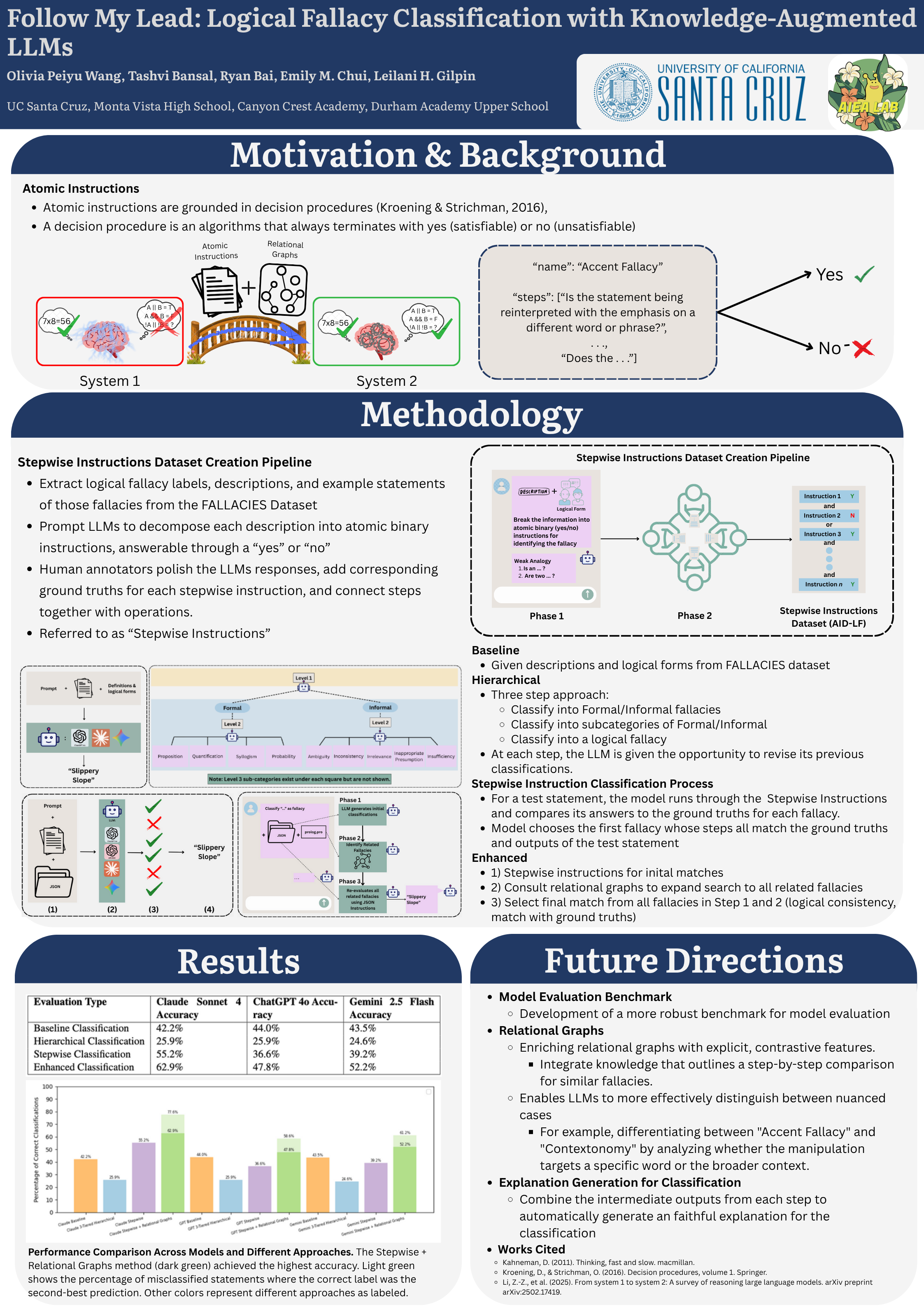
Follow My Lead: Logical Fallacy Classification with Knowledge-Augmented LLMs
Published in The Twelfth Annual Conference on Advances in Cognitive Systems, 2025
This paper applied the ideologies from decision procedure by breaking down the complex logical fallacy description into atomic questions that can be answered with “yes” or “no”. This paper intends to explore whether we could enforce LLMs to perform system 2 thinking in this way. This paper was accepted by The Twelfth Annual Conference on Advances in Cognitive Systems, and Bay Area Machine Learning Symposium for poster presentation
Recommended citation: Wang, O. P., Bansal, T., Bai, R., Chui, E. M., & Gilpin, L. H. (2025). Follow My Lead: Logical Fallacy Classification with Knowledge-Augmented LLMs. arXiv preprint arXiv:2510.09970.
Download Paper
Bridging Legal Interpretation and Formal Logic: Faithfulness, Assumption, and the Future of AI Legal Reasoning
Published in Bloomberg LSLLAI 2026, 2026
This proposal presents a neuro-symbolic approach to legal AI that combines the expressive power of large language models with the rigor of formal verification, aiming to make AI-assisted legal reasoning both capable and trustworthy, thus reducing the burden of manual verification without sacrificing the accountability that legal practice demands.
Recommended citation: Wang, O. P., & Gilpin, L. H. (2026). Bridging Legal Interpretation and Formal Logic: Faithfulness, Assumption, and the Future of AI Legal Reasoning. ArXiv. https://arxiv.org/abs/2605.14049
Download Paper
Know Your Limits : On the Faithfulness of LLMs as Solvers and Autoformalizers in Legal Reasoning
Published in AI4Law Workshop at ICML 2026; AI4Math Workshop at ICML 2026, 2026
Large language models are increasingly tested as legal reasoning tools, formalizing contract clauses into strict logic and running them through automated solvers to verify whether one statement follows from another. Our new study re-annotating real non-disclosure agreements finds this added rigor is partly an illusion. Comparing five leading models across plain LLM judgment, LLM reasoning over formal logic, and an actual SMT solver (Z3), we found that formal structure boosted accuracy, but often because models reported solver-like conclusions without actually running the solver — a failure we call scope laundering, found in every model tested and in some cases over half the time (compounded by models missing logical constraints in their own formalizations and frequently generating faulty solver code), underscoring that looking logically grounded and being logically grounded aren’t the same thing as these tools edge closer to legal practice.
Recommended citation: Wang, O. P., Wong-Toropainen, S., Amrollahi, D., Bai, R., Bansal, T., Garg, A., & Gilpin, L. H. (2026). Know your limits: On the faithfulness of LLMs as solvers and autoformalizers in legal reasoning. arXiv. https://arxiv.org/abs/2606.16118
Download Paper
talks
Follow My Lead
Published:
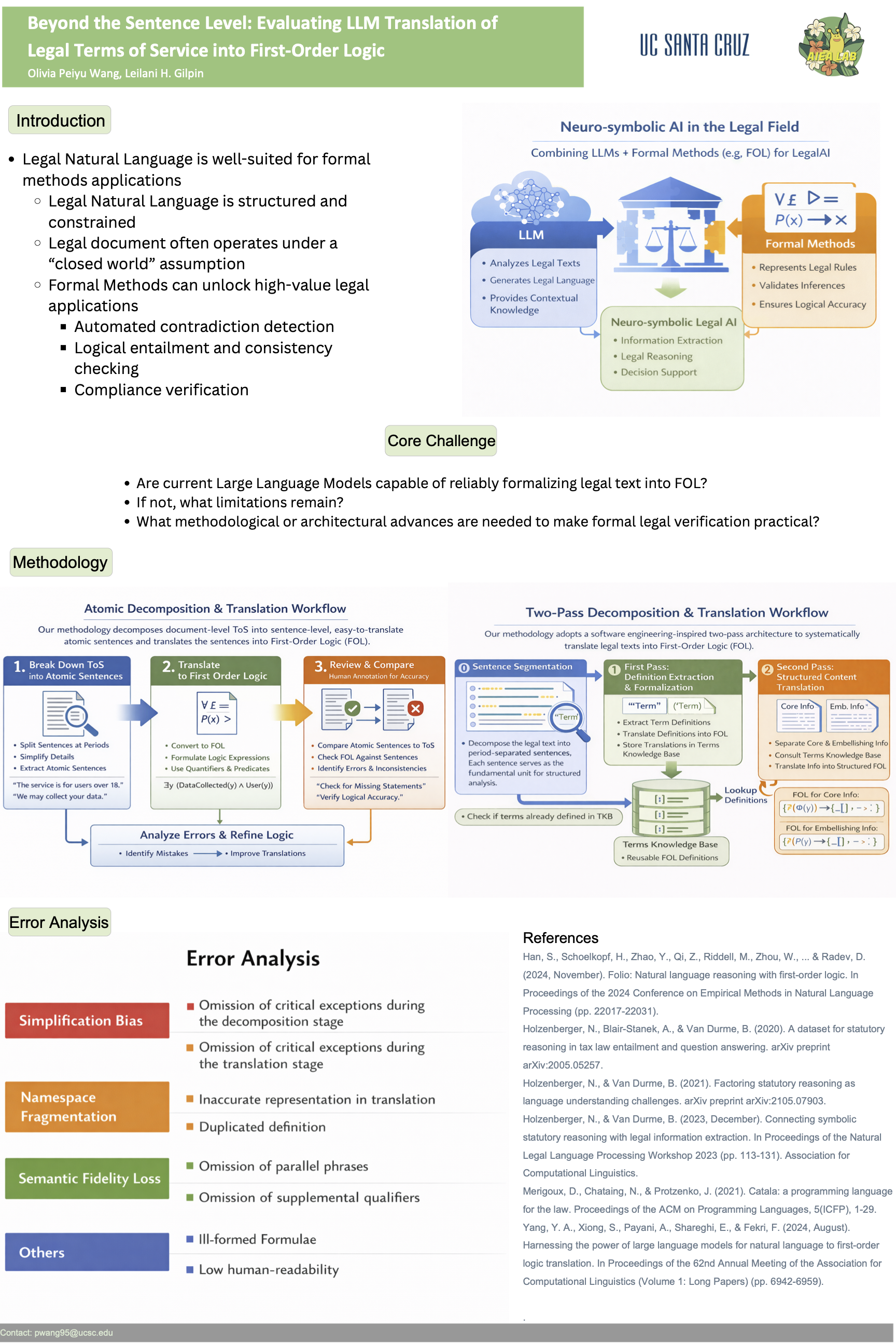
Beyond Sentence Level
Published: